


The thing about being a creative person who wants to shoot film is that the idea of numbers and technical stuff can feel… really intimidating.
And hard to understand.
So today I’m going to help you make some of the technical aspects to shooting film feel super easy.
Because I want you to take really beautiful photos on film and make sure those expensive rolls turn out right!
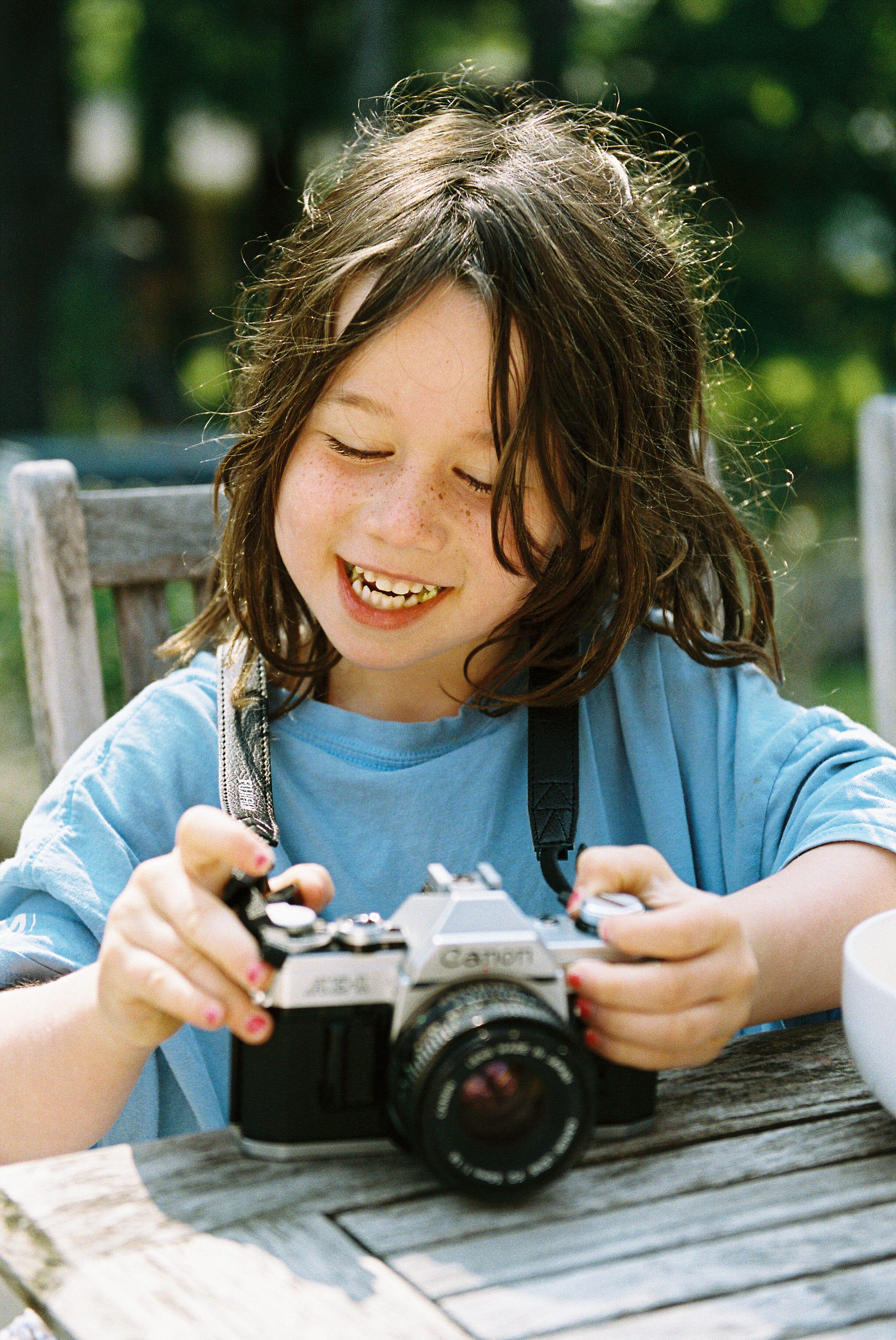
In order for your film photos to turn out beautifully (and consistently), you need to first understand exposure.
Setting the exposure of your film comes down to three things -
Aperture
Shutter speed
and ISO
Personally, I had a really hard time understanding these things when I first got a camera 20 something year ago.
I came up with a metaphor that really helped me bridge that gap. And went on to become a teaching method I used when I taught my very first photography class in 2020 - my Photography School for Parents.
The Shutter
When you take a picture, you press a button on the camera.
Which causes something called the shutter, to open and close inside of your camera (that click sound!).
To understand what the shutter is, imagine that it’s a door that lets light inside the camera to imprint on your film. The amount of light you let in is important because it will make the picture brighter or darker.
You can perfectly expose your camera and let the right amount of light in.
You can let too much light into your camera (overexposure).
You can let too little light into your camera (underexposure).
Aperture
If we think of the shutter as a door that’s opening and closing to let light in, the aperture is how wide the door is opening.
Aperture is sometimes written as f/(number).
On your camera and your light meter, the aperture is expressed as numbers ranging from - 1.4, 1.8, 2, 2.8, 4, 5.6, 8, 11, 16.
The lower the number, like f/2, the wider the door opens. And the more blurry the background of your image is (photographers call this bokeh, boh-kay).
The higher the number, like f/16, the more narrow the door opens. And the more parts of your picture are crisp and in focus.
My favorite apertures to shoot at are f/2.8, 4.0 and 5.6.
Shutter Speed
If Aperture is how wide the door is opening, we can think of shutter speed as how fast the door is opening and closing!
Shutter speed is seen on your camera a lot of times as numbers like 30, 60, 125, 250, 500, 1000 etc. It represents a fraction of time -
30 = 1/30 second
60 = 1/60 second
1/30 is slower than 1/60 of a second. The slower the door opens and closes, the more light you are letting in. The faster the door is opening and a closing, the less light you are letting in.
The more slowly you open and close the door - 1/30, 1/15, 1/8 - that is called dragging the shutter (you’re dragging and taking your sweet time opening and closing that door!).
You can use slower shutter speeds to capture motion blur and movement (the slower you open and close that door, the more blurry your subject will be if they are moving).
If you want a really crisp, sharp image - even when your subject is moving fast - you want to use a faster shutter speed to capture it. The standard shutter speed for capturing movement is 1/250 of a second or faster (1/500, 1/1000, etc.).
ISO
Now let’s talk about ISO. ISO is also referred to as your film speed.
Portra 400 = ISO of 400
Portra 800 = ISO of 800
Okay thinking back to the idea that the shutter is like a door… and we are controlling how fast and wide that door opens and closes to let film in and make a bright or dark image…
My absolute favorite way of thinking of ISO is… how many little guys with flashlights are you bringing in the room to light things up.
ISO 200 = You have 200 little guys with flashlights. So you want to use this film speed in a situation where there is a lot of light available in the scene you’re shooting.
ISO 400 = You have 400 little guys with flashlights. ISO 400 film is like a goldilocks film as you can use it in moderate situations, you can use it when it’s bright out, and when you’re an advanced shooter you can even start to use it in lower light situations. But we’ll talk about that another post.
ISO 800 = You have 800 little guys with flashlights. So this gives you more light available to you with your film to brighten the image. The less light available in the scene you’re shooting, you would want to use a film with more flashlights to brighten up your photo.
ISO 3200 = You have 3200 little guys with flashlights! So if you’re shooting in a scene with very little light, you can use this film speed to give you more support to brighten it!
Now that you know what Shutter Speed, Aperture and ISO are, the next thing is to learn how to determine those settings each time you shoot (your exposure).
Go read this post I wrote all about that - How to Nail Your Film Exposures (Every Single Time).
And my all-time favorite, Why Picking Up The Camera More Can Make Your Life Better.
Would love to know, did this teaching metaphor make sense to you?
Share any questions or comments below, would love to hear from you!
Thank you so much for reading!
xo
Suzy
Want to learn to shoot film like this? My course How to Shoot Film walks you through it all, from loading your first roll to shooting a real session. Take a look here
Can’t wait to read this!